IOSS Covers VAT. It Has Never Covered Duty. Here’s Why That Changes Everything.
Businesses selling into the European Union have long been told a comforting half-truth: that the Import One-Stop Shop (IOSS) makes cross-border compliance simple.
It doesn’t. IOSS solves one problem, VAT, and from 1 July 2026 a far larger one, customs duty, lands on the very parcels that businesses assumed were safe.
What IOSS Actually Does
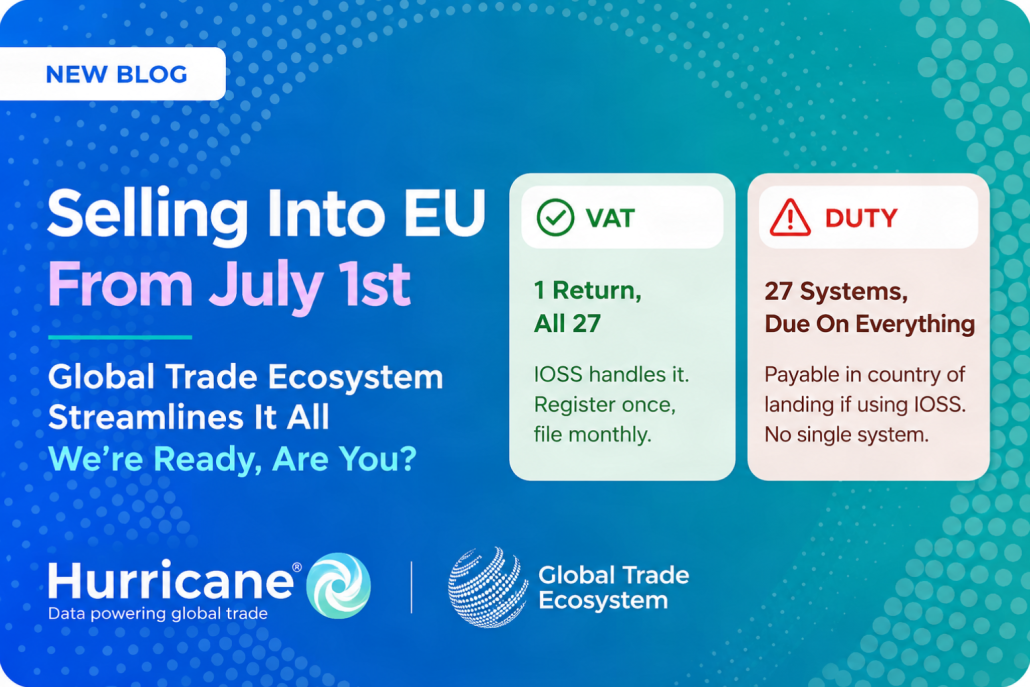
IOSS is a genuine simplification, but a narrow one. It lets a seller register in a single EU member state, file one monthly VAT return, and have that VAT redistributed across all 27. It is, however, VAT only, and it applies only to consignments not exceeding €150. It has never paid any customs duty, because until now those low-value parcels attracted none.
What Changes on 1 July 2026
The EU is abolishing the €150 customs-duty exemption two years ahead of schedule. Every parcel entering the EU becomes liable to duty regardless of value, with an interim flat duty fee of €3 per item applied to low-value consignments, explicitly tied to IOSS registration. VAT is not payable on the €3 duty under IOSS.
A separate EU-wide handling fee, and product identifiers follow from November 2026. A date that may move forward. With roughly 4.6 billion low-value parcels entering the EU in 2024, a duty obligation is being created where, for most sellers, none existed before.
If the shipment exceeds €150 then it may benefit from a Free Trade Agreement, where no charges will be applied. So, a pair of socks could make all the difference.
“There’s a dangerous assumption baked into the market, that IOSS means compliance is handled. It never did. IOSS is a VAT return. It does nothing for customs duty, and on 1 July the duty bill arrives for billions of parcels that were previously exempt. The businesses that understand the difference early will be the ones that survive this transition. Underpinning all of this though is complete, accurate, customs-ready data.”
Martyn Noble, CEO, Hurricane Commerce.
Duty and VAT Run on Entirely Separate Rails
VAT under IOSS is centralised and elegant. Duty is not. It still requires a customs declaration in the country where the goods land, accurate compliant descriptions, HS classification, country-of-origin data and a tariff calculation, processed through that nation’s own electronic system, it needs an ICS2 declaration, but not a customs clearance.
The 27 EU member states each operate distinct import systems, portals and payment calendars. IOSS leaves that landscape entirely untouched. From July, more declarations, not fewer, will flow through those systems.
Complete, Accurate Data Is the Only Way Through
This is precisely the gap Hurricane closes. Our compliance and classification engine checks the customs requirements, including complete and accurate descriptions, HS code classification, duty and tax calculation, denied parties screening and restricted goods checks at industry-leading speed. Our Global Trade Ecosystem connects data, compliance, payment, clearance and logistics through a single integration, orchestrating any trade lane without re-engineering. Where IOSS handles the VAT return, Hurricane handles the data that actually clears the goods and ensures that customs won’t reject it because of a poor description.
The results speak for themselves. Hurricane customers have seen data accuracy climb from 30 per cent to over 98 per cent, parcels held at customs through poor descriptions and incomplete data fall from 38 per cent to less than 0.5 per cent, and duty and tax calculations reach 99.7 per cent accuracy. This is higher than any other provider in the market, and we’re getting better each week. With 55 per cent of online shoppers abandoning carts over cost surprises, transparency at the point of sale is no longer optional, it’s revenue.
“IOSS told sellers the hard part was over. From July, the hard part begins. Duty is back, on everything, and the only way through is complete, accurate, machine-ready data. Oh, and if you choose to return the goods, that €3 fee you paid is non-refundable, so getting everything right before it lands is now crucial.”
Martyn Noble, CEO, Hurricane Commerce.
Data Is Core Infrastructure, Not an Afterthought
As the EU rewrites the rules for low-value trade and the 27 member states modernise their import systems in parallel, posts, importers, carriers, retailers and brokers need to treat data as core infrastructure, not an afterthought.
To learn how Hurricane Commerce simplifies cross-border trade, get in touch or book a demo today.
Hurricane Commerce provides AI-driven data services and orchestration for cross-border trade. Its solutions remove customs barriers for postal operators, carriers, retailers, customs brokers, freight forwarders and marketplaces worldwide, enabling faster clearance, lower costs and a superior customer experience.
Contact us to discuss how Hurricane can prepare your operation for the EU’s 1 July 2026 customs duty changes.